The Ten Golden Rules of Leadership: Classical Wisdom for Modern Leaders by M.A. Soupios & Panos Mourdoukoutas
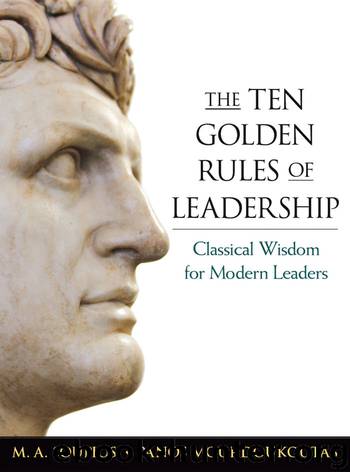
Author:M.A. Soupios & Panos Mourdoukoutas
Language: eng
Format: mobi
ISBN: 9780814434680
Publisher: AMACOM
Published: 2014-11-04T14:00:00+00:00
How to nurture competition:
Be a keen assessor of human personality—including your own
Identify subordinates who are receptive to competitive challenges
Avoid utilizing subordinates who can turn competition into antagonism
With these premises in mind, we can now consider a hypothetical situation illustrating the salutary effects of Hesiod’s constructive strife. Let us imagine that a major corporation needs to devise the most effective means of promoting a new product line. The unit in charge of advertising is divided in terms of how best to structure the campaign. One group feels the best plan would be to draw a series of aggressive comparisons between the new product and similar items available from the competition. Another group within the advertising division believes a better method of promotion would be a campaign stressing the corporation’s long-acknowledged status as a trusted industry leader. In response to these divergent views, the manager decides upon a tactic sometimes referred to as “creative tension.” The advertising team is divided into two subunits reflecting the two different approaches. Both groups are tasked with creating a detailed campaign, which will then be submitted to senior management for final evaluation. The winning project will form the centerpiece of a national campaign. The leadership is careful to present the plans in competitive terms, as a kind of agon between Team A and Team B. Team members are made aware of special financial incentives earmarked for members of the winning group. In addition, word of the “contest” is vigorously promoted throughout the organization.
Over time, this promotion creates a certain buzz within the company with the result that the project takes on a special status. Team members begin to recognize that this is not simply another job assignment. Increasingly, they understand that the entire organization is watching and waiting to see the outcome of this rivalry. As a result, team members invest the operation with degrees of time, effort, and creative commitment rarely seen. As the process continues, those involved become more and more engaged on a personal level. Success is no longer about securing a bonus check. It becomes a matter of esteem, rank, reputation, and personal pride. In the end, the winning campaign goes on to become a smashing success, illustrating the benefits an organization stands to receive by accessing the agonistic energies of its personnel.
While imaginary, the foregoing scenario contains an important life lesson: Human ambition, when properly managed, can play a critical role in fulfilling organizational objectives. Implicit in all this is a distinction between workers who simply punch the clock—mechanically conform to their daily work requirements—and personnel who are deeply committed to achieving exceptional levels of job performance. The former are content with mere compliance while the later define success in terms of a personal standard whose criteria exceed those mandated by the organization. Motivation of this sort, what we might call “impulsions from within,” is an all-too-rare phenomenon in large, complex institutions. Nevertheless, such motivation must be made a pivotal concern of any real leader because failure to tap into motivations of this kind means the organization is denied any real ability to achieve its full potential.
Download
This site does not store any files on its server. We only index and link to content provided by other sites. Please contact the content providers to delete copyright contents if any and email us, we'll remove relevant links or contents immediately.
| Anthropology | Archaeology |
| Philosophy | Politics & Government |
| Social Sciences | Sociology |
| Women's Studies |
The remains of the day by Kazuo Ishiguro(9000)
Tools of Titans by Timothy Ferriss(8396)
Giovanni's Room by James Baldwin(7346)
The Black Swan by Nassim Nicholas Taleb(7130)
Inner Engineering: A Yogi's Guide to Joy by Sadhguru(6796)
The Way of Zen by Alan W. Watts(6614)
The Power of Now: A Guide to Spiritual Enlightenment by Eckhart Tolle(5784)
Asking the Right Questions: A Guide to Critical Thinking by M. Neil Browne & Stuart M. Keeley(5775)
The Six Wives Of Henry VIII (WOMEN IN HISTORY) by Fraser Antonia(5515)
Astrophysics for People in a Hurry by Neil DeGrasse Tyson(5190)
Housekeeping by Marilynne Robinson(4449)
12 Rules for Life by Jordan B. Peterson(4305)
Ikigai by Héctor García & Francesc Miralles(4275)
Double Down (Diary of a Wimpy Kid Book 11) by Jeff Kinney(4273)
The Ethical Slut by Janet W. Hardy(4253)
Skin in the Game by Nassim Nicholas Taleb(4250)
The Art of Happiness by The Dalai Lama(4130)
Skin in the Game: Hidden Asymmetries in Daily Life by Nassim Nicholas Taleb(4007)
Walking by Henry David Thoreau(3962)
